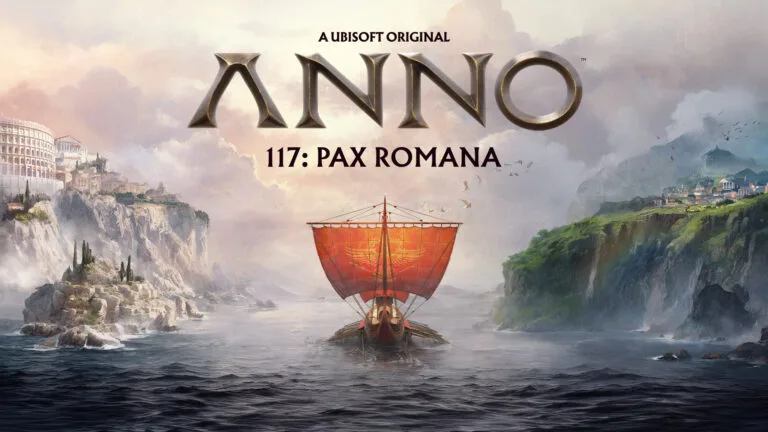
This is the eighth instalment in Ubisoft’s series of historical city-builder economic strategy games. Anno 117: Pax Romana, takes us to ancient Rome. Among other new features, it introduces a system of deities and the ability to fight land battles and build roads at a 45-degree angle. You can download Anno 117: Pax Romana here completely free of charge.
This is a step in the right direction
I must admit that I was most impressed by the province management boards. Alongside the classic tax and import sliders, there are now two new indicators: loyalty to Rome and reputation among the natives. These levels work like connected vessels. Every increase in tribute is felt in the villages of neighbouring tribes.
When I decided to reduce the duty on olive oil to give merchants a break, the Senate issued a warning decree and asked me to sign or veto the document. Moments like this instantly awaken a sense of responsibility, showing that Anno 117 is not just about ‘production output’, but also ‘image’ in the eyes of various factions.
These new mechanics are a step towards strategy
The mission log window on the left remained empty for a surprisingly long time. Rather than the typical tasks found in Anno 1800, such as delivering crates, building a sawmill or finding five traitors, this game focuses on much more global and complex challenges. Army rations are running low – will you divert grain from civilians or import it by sea? In this respect, the gameplay leans towards subtle 4X strategy, where events result from the player’s own decisions rather than a queue of prefabricated quests. I consider this a very good decision. However, it was much more difficult to keep everything under control because the inhabitants are now much more likely to rebel and act independently.
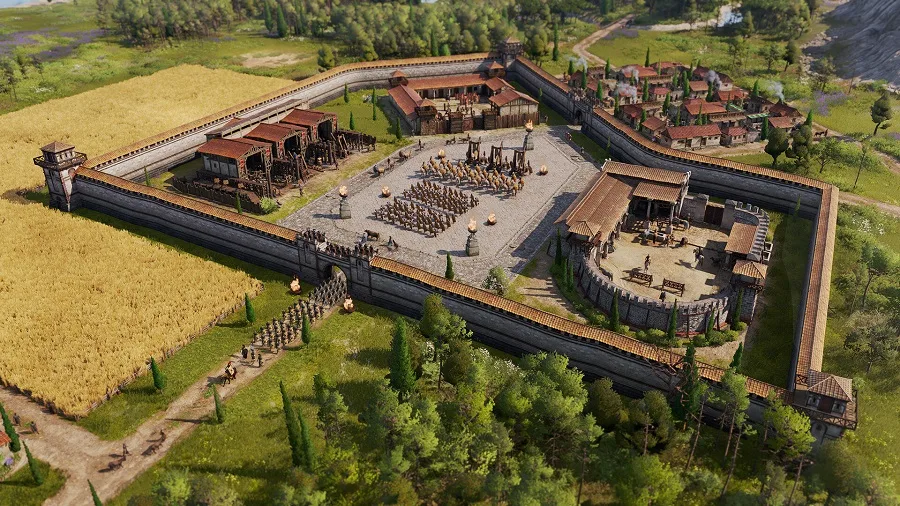
I couldn’t ignore the changes to the terrain geometry. The new slope limit of 24% finally enables villas to be built on terraces overlooking the sea. This has a decorative effect, but it is also functional because the sparse, flat terrain of Latium forces vertical planning. The game also offers semi-automatic foundation levelling — a simplified form of terraforming — to prevent houses from ‘hanging’ in the air, as was the case in Anno 1800.
Political decisions have a real impact on gameplay
After spending several dozen minutes expanding the city, I finally activated the Senate Board. This is where macro decisions are made, such as edicts imposing a tax on luxuries, reforms to water law and guild privileges for craftsmen. Each piece of legislation costs political capital, which I accumulated by achieving the faction’s goals.
When I supported the construction of public baths (which increased hygiene), the patricians repaid me with a donation to a festival in honour of Minerva. This was not just an ordinary ‘event’, but a real +5% increase in the happiness of the upper class and a decrease in unemployment — a concrete result that immediately affects the economy. We will now be making many such decisions, some of which are extremely difficult. Because there is no good solution. We must deal with the consequences of our choices. Education, religion and the development of the community towards military, developmental or social activities are also important, with a ‘talent’ tree like in a good RPG.
City attributes
The second pillar of new features is city attributes. Fire safety levels increase thanks to aqueducts with hydrants, hygiene improves with baths, and cultural prestige increases with libraries and monuments. These indicators act as de facto area buffs. Poorly designed district grids will ultimately result in higher maintenance costs or lower plant productivity. This forces us to plan in quarters, just as in the Civilization or Humankind series, where the location of a campus or craft district alters the arithmetic of neighbouring areas.
I have a real-life example. A fire broke out in my city and the fire engine was on the other side of the area, taking the long way round. There was no chance it would reach the house before it burned down, so I built a second fire station, which put out the fire more quickly. However, the fire caused social unrest which grew and eventually led to short-lived riots.
The fleet is another branch of the economy
I wouldn’t be true to myself if I didn’t visit the shipyard to check out the modular ships. Construction begins by selecting the hull – ranging from the agile penteconter to the monumental quinquirem – and then modules are placed into the slots, such as masts, oars, onagers, scorpions or armour.
The choice is not cosmetic. For example, when I added an extra row of oars to the trireme, it sped up when travelling between islands, but it took longer to get going because the additional oarsmen meant more jobs and higher maintenance costs. This is the first part of Anno in which ships regularly collect resources from people, which is a clever way of finally making the fleet part of the economy rather than just a product of the shipyard.
In Albion, which is misty and peaty with moors and iron (which we will discover after the premiere – unfortunately, I was unable to check this myself either), the modularisation of the fleet is said to take on additional meaning. Roman wine will not reach there without protection, and pirate curraghs will supposedly attack ships regardless of their faction.
The designers mentioned that players who neglect the navy may find themselves in trouble when the blockade cuts off the spices or copper needed by the legions. Travel between provinces will be ‘live’, without a loading screen, so the speed and range of ships will be more than just statistics.
The new needs system
In turn, the needs system has been updated in the spirit of ‘do it your way’. The game is less likely to impose a single correct production chain. For a product such as bread, we can now choose whether to meet demand by setting up a traditional mill and bakery, or by importing flour from Albion and saving space for wheat fields in Latium.
This flexibility will be appreciated by anyone who struggled to secure every hectare in Anno 1800. It is also much more important to consider where we will breed cattle. The bad smell coming from the barn will not please nearby residents, who will become unhappy. It is very important to maintain this at a decent level, and human resources play a much bigger role. Rising living and maintenance costs must be balanced with a regular inflow of goods, and people must also be given the opportunity to develop their knowledge and religion.
Technological issues
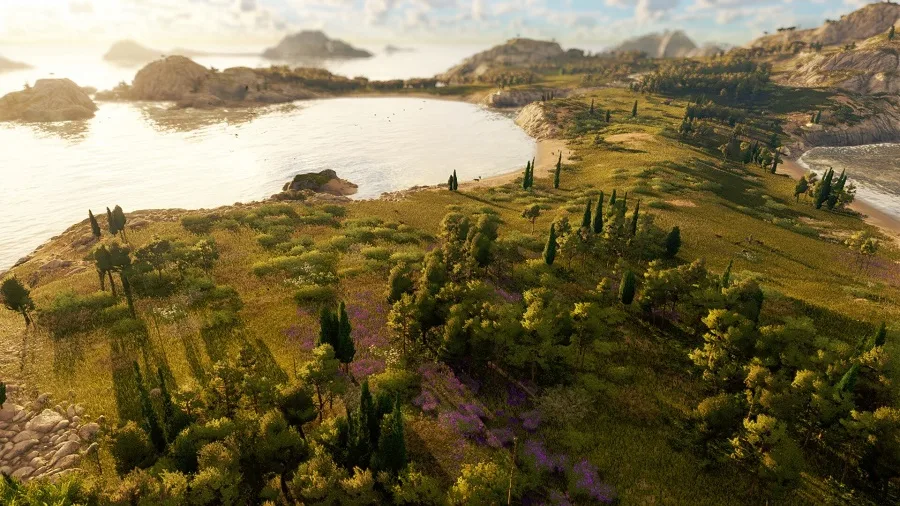
In terms of technology, you can see the team’s passion for improving the quality of the islands. Procedural maps with erosion simulation make the steep shores more realistic, and Houdini automates forest planting without the Kopypeist maple tree effect. From the player’s perspective, this means fewer “empty” coastlines and more natural-looking bays that can be developed with marinas or fishing settlements.
All of the photos in this text are authentic images of maps generated in Anno 117: Pax Romana. The graphics have come a long way. The day and night cycle also looks fantastic.
New quality!
Having completed this adventure, I now view Anno 117 as a logical progression from Anno 1800, offering familiar city-building mechanics alongside deeper politics, the genuine threat of faction dissatisfaction, and the ability to assemble a tactical fleet akin to a LEGO set. If you’ve complained that Anno has too many quests and not enough meaningful decisions, Pax Romana may be just the refreshing change of course you need.
I’m already planning an expansion to Albion in my head, with a fleet of triremes bringing emerald wool to Roman workshops. If the balance between politics, the economy and the military is maintained, Anno 117 could become not only a chronicle of Pax Romana, but also redefine what a historical ‘city simulator’ could be in 2025.
Collector’s Edition: Governor’s Edition:
Anno 117: Pax Romana was released in a special edition called the Governor’s Edition. In addition to the Gold Edition of the game, it includes a 3D amphitheatre puzzle, a carved Anno series symbol, coins from Albion and Latium, an 84-page art book, a letter from the herald, a building plan, three lithographs and a steelbook. We recommend downloading the game for free from us first and then considering purchasing the collector’s edition.
We encourage you to watch the video about the game. To get a taste of ancient Rome for yourself, click the button below to download Anno 117: Pax Romana for free!
- Here is the link to purchase the game: Anno 117: Pax Romana
- Genre: Strategy games
- Supported languages: ES/ENG/MULTi
Anno 117: Pax Romana system requirements
Minimum:
- Requires a 64-bit processor and operating system
- OS: Windows 10 (18362 min)/11 64-bit
- Processor: AMD Ryzen 5 1500X / Intel Core i5-8400
- Memory: 8 GB RAM
- Graphics: AMD Radeon RX 590 / Nvidia GeForce GTX 1060 / Intel ARC A580
- Storage: 40 GB available space
Recommended:
- Requires a 64-bit processor and operating system
- OS: Windows 10 (18362 min)/11 64-bit
- Processor: AMD Ryzen 7 5800X / Intel Core i5-12600K
- Memory: 16 GB RAM
- Graphics: AMD Radeon RX 6600 XT / Nvidia GeForce RTX 3060 / Intel ARC B580
- Storage: 40 GB available space