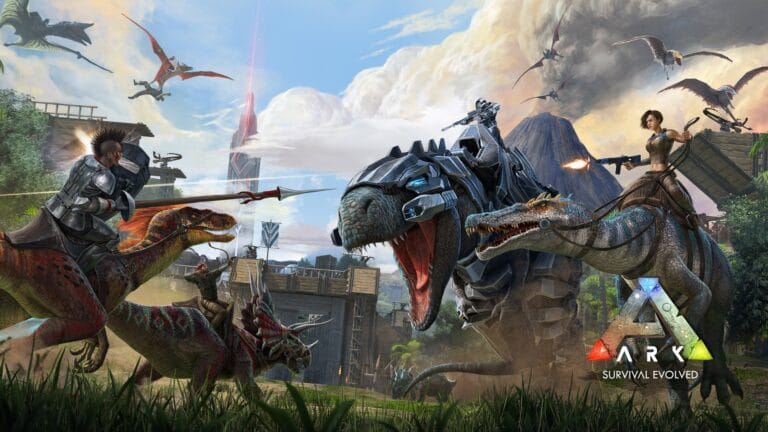
At first glance, ARK: Survival Evolved seems like an unusual game. The survival adventure genre is certainly not as popular as action games. Developed by the American studio Wildcard, the game also offers a multiplayer mode in which our character is threatened by dangerous animals and other players. You can download Ark: Survival Evolved for free here.
In the article:
Fighting to the death in this world adds flavor to the whole experience. The developers asked, “What if…?” and created a location where we encounter animals that never had a chance to coexist in reality. In the battle for survival, we hunt dinosaurs and Ice Age megafauna.
ARK: Survival Evolved primarily focuses on human survival and creating an increasingly advanced human community. Here, in addition to fighting for our lives, we also fight for our heritage—technology, tribe, and settlement. These components form a potential mini-civilization in ARK: Survival Evolved.
Digital dinosaurs
Before conquering the world, it would be wise to learn what kind of fauna we will encounter. The animals we encounter are often not real species but variations of real ones created by the developers. This is the case with the various dinosaurs we see from the beginning of the game.
We usually imagine dinosaurs as huge, bloodthirsty lizards. In ARK: Survival Evolved, however, we encounter both herbivorous and carnivorous species that move on two or four limbs and come in various sizes. There are predatory raptors, peaceful brontosaurs, and curious compsognathus. Just like in reality, the dinosaurs in the game have taken over almost every niche. Analysis of fossils shows that some were capable of gliding and others led semi-aquatic lifestyles.
The beginning of the dinosaur era is associated with a mass extinction event on Earth. The Permian extinction, which occurred approximately 245 to 250 million years ago, wiped out over 90% of life on Earth. Dinosaur ancestors are believed to have first appeared 230 million years ago as small, bipedal reptiles that gradually evolved to dominate the fauna of all continents.
Dinosaur hegemony, which lasted throughout the Jurassic and Cretaceous periods, ended with their extinction. Sixty-six million years ago, the Cretaceous extinction occurred, eliminating at least 75% of the animal species that existed at that time. It is widely accepted that this extinction event was caused by a meteorite impact. Among the survivors were the reptilian ancestors of today’s birds.
Let’s go, mammoth!
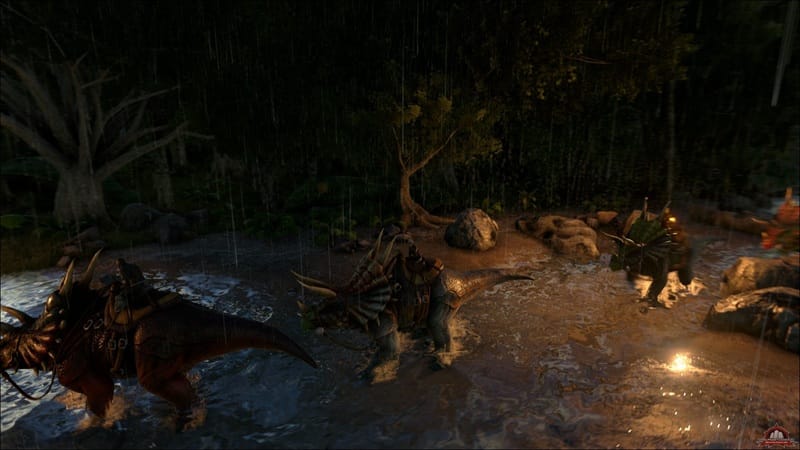
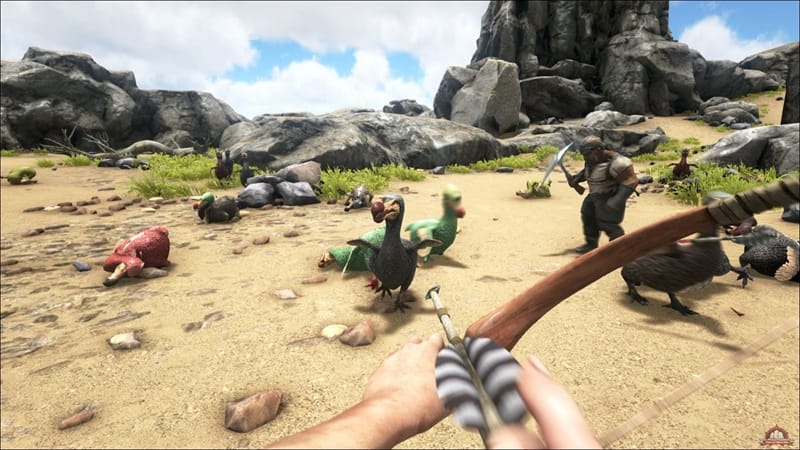
In ARK: Survival Evolved, we can domesticate various animal species encountered during the game. These pets can include diplodocuses, horses, scorpions, vultures, and mammoths. However, the domestication process is not easy. It requires patience, resources, and time.
Having your own breeding stock is practical — animals help players survive. We control our charges using commands, and they assist in farming and gathering resources. Some can be used for transport, scouting, and combat. Of course, such animals must be tamed.
There are several ways to domesticate animals. Some species must be stunned and then fed. Another method is to tame them by feeding them without using violence. Some animals, on the other hand, must be saddled after being stunned. The effectiveness of the taming process depends on the food we feed our future pet, among other things.
As we learned in history class, many species have been domesticated in different parts of the world. This lengthy process occurred alongside the gradual transition of humans from a nomadic to a sedentary lifestyle. Today, animals serve many purposes, such as providing food and raw materials, performing work such as transport, hunting, and service, and serving as decorations and sources of entertainment, such as horse racing.
Strength in numbers!
It’s hard to imagine how humanity would have developed if our ancestors hadn’t cooperated with each other. Surviving alone, especially when armed only with a spear, can be problematic if we have no one to support us in defeating a predatory opponent. The same is true in ARK: Survival Evolved, but the developers anticipated this problem and implemented the ability to create your own tribe.
By uniting in a tribe, group members can pursue a common goal, such as building and defending a settlement or hunting. An additional advantage is that performing various activities in the presence of a fellow tribesman results in bonus experience points, accelerating advancement to the next level.
Depending on the group’s arrangements, your pet can become the tribe’s property and remain there even if you leave. Otherwise, tribe members can give it commands. We solve the issue of property brought to the community similarly — it can be communal or private.
In the struggle for survival in the wilderness, alliances or wars with other tribes often form. In such conditions, conflict is likely, especially when resources are scarce and we know our neighbors have an abundance of them. This is not surprising; we know of similar cases of intertribal conflict throughout history. These conflicts were often bloody.
No fun without resources!
As we progress in the game, we unlock new engrams, or patterns for crafting items. These include weapons, clothing, and architectural elements. Each invention requires obtaining the right amount of resources, such as wood, stone, or plant fibers. After collecting the materials, we begin crafting the item, a process that can sometimes be quite time-consuming.
Engrams may seem arranged chronologically according to the order in which a given item was invented by humanity. However, our character can quickly learn the pattern for a blood transfusion syringe bag while using only a slingshot for defense. Despite the lack of reference to actual chronology, ARK: Survival Evolved addresses the issue of human development at an accelerated pace.
Above all, it illustrates how problematic the availability of raw materials can be. Conflict with a tribe hindering our acquisition of materials can limit our group’s technological development and leave us defenseless. Such situations are also familiar to us from history. For example, consider the crisis in the eastern Mediterranean basin that took place at the turn of the 13th and 12th centuries BCE.
The Hittite Empire collapsed at that time, most likely due to the Sea Peoples seizing trade routes, which led to famine and internal destabilization.
The interruption of supplies to Mycenaean Greece, including copper and tin used to produce bronze for military purposes, led to devastating internal conflicts over raw materials. The Dorian invasions sealed the fall of Mycenaean culture.
With a hoe for tomatoes
Without food, we cannot survive in ARK: Survival Evolved. To survive, it is important to obtain food from several sources. In addition to hunting wild animals, we can devote ourselves to gathering and working the land.
To create your own plot, you need to find plant seeds. Then, place the seeds in boxes designed for this purpose. Use fertilizers made in composters to stimulate plant growth. You can use manure as well, but it will not be as effective.
There are three ways to provide water to plants: watering them directly, irrigating them using an irrigation system, and through rainfall and snowfall. Once the conditions are right, we can build a greenhouse where our seedlings will grow faster with less fertilizer. The culmination of our efforts is the harvest, which we begin after a certain period of time.
The gradual transition from a hunter-gatherer economy to an agricultural economy is known as the Neolithic Revolution. This process developed independently in different parts of the globe, but it is usually associated with the Fertile Crescent in the Middle East. The beginnings of agriculture date back to around 10,000 BCE. The increased food supply led to population growth and, consequently, the emergence of civilization.
Waiting for Offspring
The result of our interference in the world of ARK: Survival Evolved is the reproduction of selected domesticated individuals. If they are kept in a confined area or walked together, our pets may become interested in each other. Depending on the species, mating will result in either an egg or pregnancy in the female.
As in reality, the right air temperature is essential for the development of the baby dinosaur. Without warmth, our efforts to breed a small dinosaur may be unsuccessful. In the case of a pregnant female, we must ensure that she has enough food — after all, she is eating for two.
When the baby is born, it must be accepted into the herd. It requires a lot of food and constant care, especially in the early stages. If we don’t prepare supplies in advance, we may be in for a big surprise, as litters can have up to three babies.
As in real life, selecting the best individuals brings us closer to achieving the desired characteristics in our herd. If we pay attention to the baby as it grows and feed it the right food, its initial stats may improve. Importantly, young animals may be affected by a mutation, which can affect their potential or appearance.
Click below to start downloading ARK: Survival Evolved for free.
- Here is the link to purchase the game: ARK: Survival Evolved
- Genre: Action Games
- Supported languages: ES/ENG/MULTi
ARK: Survival Evolved requirements
Minimum:
- OS: Windows 7/8.1/10 (64-bit versions)
- Processor: Intel Core i5-2400/AMD FX-8320 or better
- Memory: 8 GB RAM
- Graphics: NVIDIA GTX 670 2GB/AMD Radeon HD 7870 2GB or better
- DirectX: Version 10
- Storage: 60 GB available space