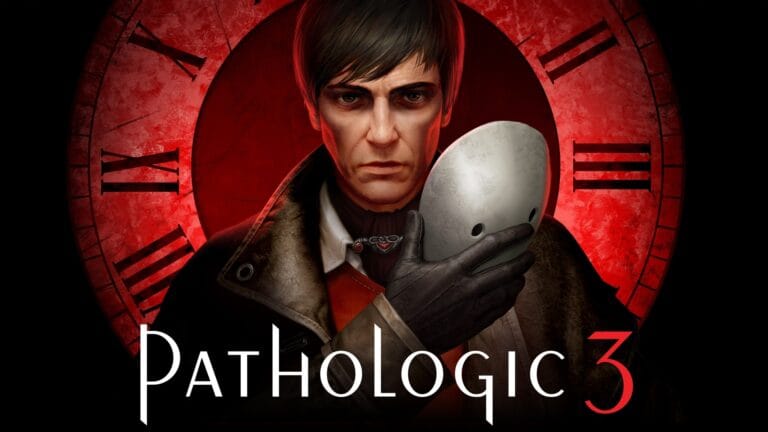
In Pathologic 3, folk wisdom clashes with a scientific approach. The lives of ordinary people clash with dreams of utopia. The player’s determination collides with successive obstacles maliciously thrown in their path by the developers. Would you like to experience the game for yourself? Download Pathologic 3 now!
In the article:
Pathologic 2 is my favorite game. It was such a wildly successful remake of the original that my expectations for the third installment became a source of anxiety. Ice-Pick Lodge, the Russian studio that moved to Kazakhstan after the invasion of Ukraine and condemned Vladimir Putin’s actions, has no shortage of incredibly talented people. However, the bar was set so high that they might not be able to meet it. After the company ended its cooperation with its founder, doubts arose as to whether the artistic success of Pathologic 2 could be repeated. Well, it was—and then some!
Pathologic 3 is another remake of one of the paths from the first part of the series. Once again, we find ourselves in a fictional Russian-inspired country and equally fictional times, most likely the late 19th or early 20th century. This time, we see the world through the eyes of Danil Dankovsky, a doctor who dreams of defeating death. This desire draws him to a nameless town in the eastern steppes where an exceptionally long-lived man named Simon Kain is said to live. Unfortunately for Dankovsky, Kain dies on the day he arrives, and an extremely dangerous epidemic breaks out in the city. The player must perform medical duties and also become a politician, detective, judge, errand boy, and time traveler. Good luck!
It’s hard to say unequivocally what genre Pathologic 3 belongs to, but it’s probably closest to an RPG with mechanics similar to those of simulators. We diagnose patients and manage the city using special menus and by issuing decrees. Most often, however, we run from one character to another (sometimes traversing dangerous neighborhoods) to tell them something or ask them for something. Although there are elements of combat, they are not the main focus. The real battle does not take place in the infected or rebellious parts of the town, but within ourselves.
I call this intellectual survival
I call the key challenge offered by Pathologic 3 “intellectual survival.” Its nature is twofold. First, it refers to the protagonist. Second, it refers to the player themselves. Let’s start with the former and take a quick look at the game mechanics (because it’s impossible to discuss them all).
In Pathologic 2, the main character, Artemii Burakh, was primarily concerned with what he would eat and drink and where he would spend the night. Controlling him was survival—perhaps not classic, but comparable. Dankowski, on the other hand, is a character with his head in the clouds. Physical needs are irrelevant to him — he teeters on the brink of mania and apathy. It is Dankowski’s mental health that we must take care of if we want to succeed in the game.
Various substances and elements of the environment will help us do so. Digging through trash cans or swinging on a swing to avoid dangerous mental states is part of exploring the city. Illness is not as deadly to Dankowski as his own restless mind. This technique deepens immersion, allowing us to view the game world differently than Burakh did.
However, players also experience intellectual survival because dialogue in the Pathologic series is equivalent to combat in action-focused titles. Selecting the incorrect response can abruptly conclude an essential quest line or initiate one that is best avoided. In the third part, specific statements increase our character’s mania or apathy. Therefore, if we don’t have any healing substances with us, we should think twice before choosing an answer. However, this is purely a gameplay issue. Survival also applies to our gray cells when we try to understand what someone is saying.
The script is unusually high-quality, but that doesn’t mean the story is easy to follow. In the world of Pathologic, everyone is a doctor of philosophy who communicates exclusively through mystical riddles. Don’t expect dialogue straight out of popular cinema that imitates how people really talk. Instead, prepare yourself for the experience of reading a novel by a renowned epic writer such as Fyodor Dostoyevsky. Some will find this jarring, but it is a deliberate technique. The creators are playing with video game conventions, especially those found in big-budget titles, and with players accustomed to them.
It’s not easy
Although the challenge may not seem as great as in the previous two installments, Pathologic 3 is undoubtedly not a relaxing game. There is no shortage of difficult and uncomfortable decisions, and the mechanics that are supposed to make life easier often turn against you. Time travel is the perfect example of this, as it is practically Danil’s daily bread.
As newcomers to the series, we gain the ability to jump through the timeline and repeat days at will. This allows us to make different decisions and make up for what we missed. When our choices turn out to have changed the future for the worse, all we have to do is go back and reverse everything — nothing could be simpler, right? Wrong. First, the butterfly effect and the network of connections between events are so complicated that they can give you a headache despite the interface’s attempts to explain them clearly. Second, the player feels helpless when a decision cannot be reversed. The developers use every means possible to laugh in our faces and hurt us.
Pathologic 3 doesn’t care if the player is having fun. In fact, it sometimes seems to want us to suffer. That’s the charm of this production. It’s not an escapist toy but an intellectual challenge. It’s a game that forces you to think about the nature of games as an art form and about worldview issues that clearly form the basis of the presented story.
What was the author thinking?
In Pathologic 3, we see many conflicts. The most obvious ones are political and cultural disputes. The town is de facto ruled by three wealthy families who will not miss any opportunity to harm each other. The latter result from the presence of the steppe people, a group with a different culture, language, and beliefs, clearly inspired by the Siberian Buryats. This community perceives reality completely differently, and its customs trigger various clashes, which are exacerbated by the epidemiological situation.
Of the many wars of ideas, the most significant appear to stem from the age-old conflict between intellect and transhumanist tendencies, and mundanity and the natural order. Dankowski firmly sides with the former, closing himself off in the process. He dreams of a utopia without death or disease and despises the steppe dwellers who worship nature. Although we see the world through the eyes of a man with clearly defined views, the dispute is presented as unresolvable, leaving us to draw our own conclusions.
Yes, it’s complicated, but that’s how it’s supposed to be. The themes of Pathologic 3 are universal, woven seamlessly into the plot, and the message is not intrusive. Those who want to dig deeper can do so, but those who don’t can go through the entire game without thinking about the hidden metaphors. On both levels, Pathologic 3 simply works.
Who is Pathologic 3 for?
I won’t pretend that it’s a game for everyone. In fact, many people reject the complex dialogue and other oddities that are characteristic of the series. However, those who want an intellectual challenge and are curious about the potential of games as a medium should at least give it a try. Incidentally, I can’t imagine a better opportunity to get into the entire Pathologic series. In terms of gameplay, Pathologic 3 is the most accessible game released so far.
But will veterans of previous installments find something for themselves here? Absolutely. The game is full of references and meta-comments about the second and first installments, but it also has many new storylines. It’s a different game with innovative solutions and mechanics, yet it maintains the series’ spirit, boasting the same finesse and artistic flair.
Despite my enthusiasm for the game, I have one complaint: in the final stages, it’s easy to encounter bugs, some of which are more serious than others. This is probably because most players haven’t gotten that far yet. However, the developers are patching the game quickly, so I expect the fixes will be here soon.
Summary and rating
Pathologic 3 is a wonderfully designed, thought-provoking production that experiments with its own form. The narrative and gameplay form a coherent whole, offering an experience that is fundamentally different yet similar to previous installments in the series. My rating for the game is 9.5/10.
Pros:
- phenomenal storyline
- well-thought-out gameplay design
- atmospheric soundtrack
- originality
- accessible to new fans while catering to old-timers
Cons:
- there are bugs, especially towards the end of the adventure
- long loading screens
Click below to download the full version of Pathologic 3 for free.
- Here is the link to purchase the game: Pathologic 3
- Genre: RPG games
- Supported languages: ES/ENG/MULTi

Pathologic 3 system requirements
Minimum:
- OS: Windows 7/8/10/11 (64-bit)
- Processor: i3 / Ryzen 5
- Memory: 8 GB RAM
- Graphics: NVIDIA GeForce GTX 960
- DirectX: Version 11
- Storage: 25 GB available space
Recommended:
- OS: Windows 7/8/10 (64-bit)
- Processor: i7 / Ryzen 7
- Memory: 16 GB RAM
- Graphics: NVIDIA GeForce GTX 2070
- DirectX: Version 11
- Storage: 25 GB available space