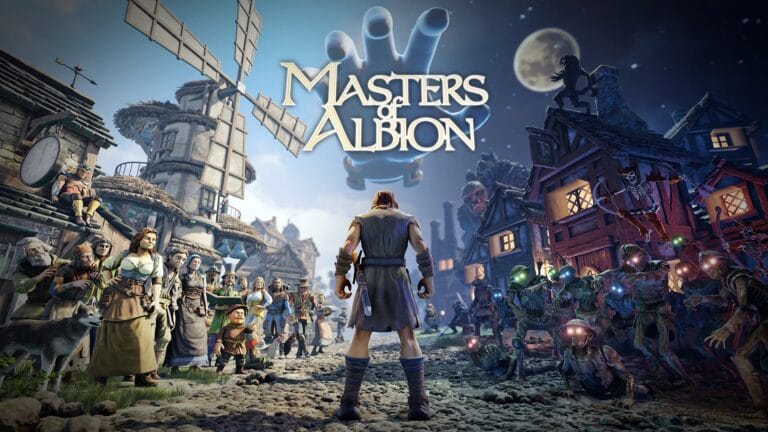
Masters of Albion is a god game, a strategy game that lets you play as a god. The game was developed by 22cans, a studio founded by Peter Molyneux, who is considered the “father” of games such as Fable, Black & White, and Dungeon Keeper. Right now, thanks to us, you can download Masters of Albion for free.
In the article:
It’s been 10 years since news about Peter Molyneux, 22cans, and their games dominated the pages of computer magazines and crashed website servers. During this time, the studio did release other games, but neither The Trail: Frontier Challenge nor Legacy could boast even a fraction of the popularity of their great predecessors. Gradually, the memory of those good—and those bad—events has faded, and Molyneux himself has ceased to be a polarizing figure. Entire generations of young gamers simply don’t know him, because they never had the chance to play Populous, Dungeon Keeper, Black & White, or Fable, and after all, a tremendous amount of time has passed since the Godus drama. So this is a rather quiet return, following a massive storm that almost no one remembers anymore. But were the right lessons learned after that flood of the millennium?
The Fellowship of the Ring
Despite everything that happened in the past, many fans of Populous or Dungeon Keeper hoped that Molyneux—if he returned—would finally focus on what he does best instead of giving interviews: god simulator games where we play as a being endowed with omnipotence. All signs point to Masters of Albion being exactly that.
To rise to the challenge, however, Molyneux has once again gathered the people with whom he conquered mountains and won the hearts of players in the past. So here we have Mark Healey—the man without whom Dungeon Keeper wouldn’t have been what it was; we have Russell Shaw (composer for DK, Syndicate, Black & White, Fable); there’s also Iain Wright (designer of Black & White 2, Fable 2, and 3); and there’s Kareem Ettouney (Black & White 2, Fable, and incidentally, the man who, together with Mark Healey, founded Media Molecule and gave the world LittleBigPlanet). With such names and such a team at the studio, it was obvious that they piqued my curiosity. I grew up on their games and still return to them regularly to this day.
A cozy game by day, a nightmare by night
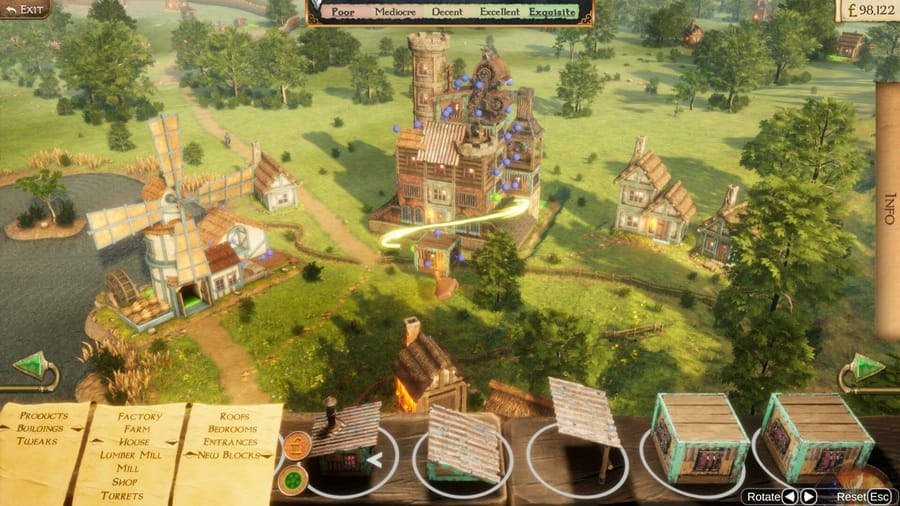
The gameplay in Masters of Albion is divided into two phases—day and night. During the day, it’s a sunny, relatively relaxing experience where you build your town, manage production, explore, and prepare for the coming of night. At night, however, the gameplay turns into a sort of tower defense with action elements, as we’ll have to fend off attacks from various monsters, skeletons, and zombies. The rule is simple, and we’re actually familiar with it from many other titles.
The devil, however, is in the details. Building isn’t just about placing one structure after another to fill the next links in the production chain. We will build structures, yes, but from parts; using our “hand of God” (the cursor characteristic of Peter Molyneux’s games), we’ll literally assemble them from blocks (Molyneux has said he loves Lego, which was clearly an inspiration here). There are plenty of blocks, and we’ll constantly be unlocking new ones—this applies to both cosmetic elements, so we can customize the look of our settlement to our taste, and functional elements. A roof, a chimney, a bedroom, a kitchen, production rooms, and many others—all of this allows us to create impressive (or monstrously bizarre) structures. Depending on which blocks we use, we’ll end up with a different building. So, if a building contains, for example, an anvil, we’ll create a workplace for a blacksmith.
Interestingly—and this is really cool—we can combine buildings. To explain this with an example: usually in other games, we have two separate buildings—a smelter’s workshop, where ore is prepared, and a blacksmith’s workshop, where weapons are crafted from it—and workers run back and forth between the two. In Masters of Albion, we can combine both buildings and create a Smelter and Blacksmith in one. Heck, instead of building a village consisting of many buildings, we can create one huge megabuilding that combines all functions and creates a smelter-blacksmith-baker-tavern-dormitory. Molyneux cautioned, however, that megabניינים lose efficiency in production, so it’s important to find a happy medium.
All this modular building looks—I’ll admit—great and truly gives the player the ability to create beautiful, strange fantasy settlements. Every single one of your buildings can look different—even if you have two bakeries, you can build them differently.
It amused me—though it’s the spirit of capitalism, and I hope our CEO doesn’t read this announcement—when it turned out that we can… put a bedroom inside a production building. You know, so that the employee doesn’t have to go home after work and waste time.
We craft our own weapons and prepare our own meals
Once we’ve cobbled together our fantastic buildings into some sort of ramshackle whole, we still have to decide what will actually be produced in them. A blacksmith won’t do anything unless we give him an order for a sword. So all the tools and dishes the kitchen treats us to will also be assembled from blocks. So, we’ll design a sword from the pommel, through the guard, all the way to the tip. Each of these parts has its own stats and will affect the final result accordingly—each also has its own price, and it might not be worth using the most expensive parts. Especially since the game… has an economy. We don’t yet fully know how it’s supposed to work, but we know it’s meant to fluctuate and regulate the profitability of production. Interestingly, specific item blocks are designated by rarity colors—just like in WoW or Diablo.
The same applies to food—we can create a delicious muffin, but we can also add a dead rat to our dish instead of fresh meat. There are supposed to be plenty of possibilities, and this is meant to be a fun diversion; however, Molyneux notes that if someone doesn’t want to spend hours on this process, it will be possible to quickly assemble an item. Of course, we’ll be rewarded for well-crafted item/dish designs, and the entire economy is based on money. We’ll use that money to unlock further elements of various tech trees.
Once we’ve crafted a dish or weapon, production will begin, and our hero—because in addition to the villagers, we also have heroes who patrol our lands and fight monsters, just like in Majesty—will set out to purchase new gear. Heroes act independently—just like the villagers, and the dishes and items we design will be used by both heroes and ordinary villagers.
Like in many of Molyneux’s past games, we play as a god-like entity, so instead of directly controlling them, we influence the decisions of our subjects. We can, of course, assign a hero or villager to a specific task (by picking them up and dropping them nearby, as in Dungeon Keeper), but we don’t control them as in a strategy game by right-clicking.
A tech tree isn’t enough—it’s a whole tech forest!
The money we earn—among other things, by fulfilling orders for specific items (meals, weapons)—will be used to unlock more items, mechanics, and bonuses in the tech trees, and there are a ton of them. Molyneux, presenting the trees, said: “I LOVE TECH TREES.” And indeed, that love is plain to see. We have four major tech trees to unlock—Peoples, Lords, Royal, and Mystic—each of which will allow us to develop various regions of our kingdom; so we have skills that unlock new buildings and production chains, new mechanics and professions, we have passive bonuses for production or combat, we can unlock defensive building blocks (ballistas, trebuchets), and we’ll also learn new spells (because we’re gods, so we have to hurl lightning bolts). We’ll unlock the Mystic Tree (with spells) differently, without using money, but by spending “Mystic Favors” —favors we earn at night by killing monsters. There weren’t that many spells in the tree, and I hope they’ll add more during early access—personally, as a Populous fan, I’m hoping for the ability to create a volcano.
Additionally, completing requests for residents fills a progress bar, which also unlocks passive bonuses—such as increased sales profits. Heroes also have their own skill tree—so there’s definitely plenty to do and ways to progress as the game develops.
Possession Returns from Dungeon Keeper
One of the standout features of the 1997 Dungeon Keeper was the Possession spell. In this game, built on the Magic Carpet engine, we viewed our dungeon from above, building, digging, and managing operations. But by using the Possession spell, we could take control of our independent, sullen creature. At that point, the perspective and genre of the game shifted—instead of strategy, we played in first-person and could charge into battle, casting spells and swinging a sword.
We get exactly the same signature mechanics from Molyneux in Masters of Albion. So we can take control of any inhabitant, but also a chicken or a dog. If, on the other hand, we take control of a hero, we can begin exploring.
The titular “Fable-esque” Albion is an island divided into regions. Initially, of course, only one region is active—the one where our main village stands. The rest is shrouded in the fog of war, and our divine powers don’t work in those areas—so we can’t build or move residents there. That’s when exploration comes in handy.
Controlling a third-person character, much like in Fable, we set off into territories outside our jurisdiction in search of adventure. I say “much like in Fable,” and it does indeed remind me of the first Fable. Especially since this aspect of the game—and combat in particular—still needs a lot of polishing, in my humble opinion. During our exploration, we’ll encounter bandits, find treasure chests, solve puzzles, destroy gargoyles that serve as collectibles (just like in Fable), and even explore accessible dungeons filled with monsters and treasures. With its help, we’ll also unlock a new region for expansion—this is done by solving a puzzle related to a lantern—the one I saw was simple; all I had to do was build a tower out of blocks using the “drag and drop” method. Unlocking new regions will, of course, bring us further benefits: blocks for building both structures and goods/food, new characters, cosmetic skins, and, of course, money.
The game has a bit of a storyline, but it’s conveyed through talking portraits—Molyneux, as he noted, isn’t a fan of the modern use of cutscenes, which pull the player away from the game. I wouldn’t expect particularly moving stories here; that’s not what his games have typically been about.
In Masters of Albion, we’ll of course be able to play as “the good guy” or “the bad guy”—I’m not entirely sure yet what specific changes this will bring, but I know we’ll be able to put people in stocks, hang them, and the background music will change accordingly. If you play as the bad guy, it’ll be gloomy and dark; if you play as the good guy, it’ll be lively and cheerful.
Nighttime Brings Nightmares
Once we’ve completed all the tasks we wanted or needed to do during the day, we can click a special icon to transition to nighttime. Molyneux emphasized, however, that it’s worth preparing for this—before nightfall, we can check (as in tower defense) which direction the enemies will come from and, using the same modular “drag-and-drop” method, — build a ballista tower (there are 4 types of towers in the game; they’re extremely expensive but effective, and they consume ammunition). We can also check what new enemies will attack us or fortify ourselves with walls. Enemies will try to attack the Crypt—a building in our town (like the Heart of the Dungeon in Dungeon Keeper)—and we must defend it at all costs.
At night, we can of course possess our hero and throw ourselves into battle personally, but from a strategic standpoint (enemies attack from several locations), it’s probably better to observe the situation from above. If our heroes and defensive towers can’t handle the task, we can use spells (by the way, when we cast lightning bolts, the fingers of our god-like hand form the sign of the horns) or pick up a boulder and drop it on a nasty zombie’s head.
Recycling the best things in the world, but what about life simulation?
This entire game has been cobbled together from elements that Molyneux and his team created long ago—managing the inhabitants and the Possession spell resemble Dungeon Keeper (or an inverted Dungeon Keeper, if only because we’re on the surface, but – as Molyneux pointed out – the world isn’t just vast on the surface; the underground is also enormous, and we’re meant to find plenty of adventures there; so I’m hoping for more nods to Keeper), spellcasting is Populous, and the division into the light and dark sides of the Force is straight out of Black & White. The exploration, meanwhile, is pure Fable. Almost every element brings to mind one of Bullfrog’s or Lionhead’s games, which will be a nice bonus for fans and a trip down memory lane. When Molyneux picked up a boulder and hurled it at an enemy, I felt like installing Lionhead Studios’ debut title.
And that makes me very happy, because first of all, a lot of time has passed since those games, and they haven’t received any remasters or remakes, and secondly—that’s exactly what they were famous for. That’s what Molyneux did best, and that’s what built his career. Let me repeat the main point from the beginning of this text—if you’re hoping for a grand drama, I don’t see it here. Masters of Albion, while interesting, doesn’t have the same ambitions as Black & White or Fable—it’s simply a base/city builder with exploration and tower defense-style defense elements. It’s just a fun little game, not a masterpiece that will change your life. And this more intimate nature suits this kind of genre—it’s simply a promising indie game.
Which doesn’t mean I don’t have my concerns—the combat I mentioned didn’t make the best impression on me. I also don’t know how the life simulation works in this game. I haven’t been able to figure out if the residents of our town lead any kind of private lives, if they do anything other than work, or if they pair up and spend their free time however they like. It’s a god simulator, so I expect those elements to be in the game—but for now, nothing is known about them.
Masters of Albion aims to be a top-notch god simulator. That’s all there is to it—and that’s more than enough. It’s a promising-looking game where you’ll do a bit of building, play designer for a while, and explore forests, meadows, mountains, and vast underground realms. For fans who can’t get over the loss of Bullfrog Productions and Lionhead Studios—and those who also miss Majesty—this is a must-play. I don’t think this god will lead us to salvation, but maybe he’ll let us spend a dozen or so hours in an immersive, beautiful, and mysterious fantasy realm. See for yourself today by downloading Masters of Albion for free.
Masters of Albion free download
Click the button below to feel divine by downloading Masters of Albion completely free.
- Here is the link to purchase the game: Masters of Albion
- Genre: Strategy games
- Supported languages: ES/ENG/MULTi

System requirements
Minimum:
- OS: Windows® 10 (64-bit)
- Processor: Intel® Core™ i5-4670 (quad-core) / AMD® FX-Series™ FX-4350 (quad-core)
- Memory: 8 GB RAM
- Graphics: NVIDIA® GeForce® GTX 1050 (2 GB) / AMD® Radeon™ RX-460 (4 GB) / Intel® Arc™ A380 (6 GB)
- DirectX: Version 12
- Storage: 10 GB available space
Recommended:
- OS: Windows® 10 (64-bit)
- Processor: Intel® Core™ i5-7600 (quad-core) / AMD® Ryzen™ 3 2200G (quad-core)
- Memory: 16 GB RAM
- Graphics: NVIDIA® GeForce® GTX 1060 (6 GB) / AMD® Radeon™ RX 580 (8 GB) / Intel® Arc™ A580 (8 GB)
- DirectX: Version 12
- Storage: 10 GB available space